No product featured
A Late-Night Job Application Claim Over an Elevator Selfie
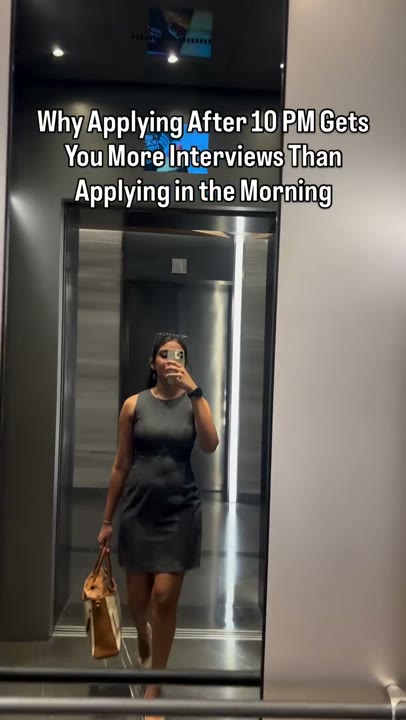
An elevator mirror selfie hooks job seekers with a text claim that applying after 10 PM gets more interviews than applying in the morning, leaving the explanation to the caption.
- Views
- 13.7M
- Likes
- 105K
- Comments
- 2.9K
- Length
- 6s
Observed : 13,732,015 views, 104,782 likes, 2,942 comments. Published . An Instagram view is a play of a video (Reels); images and carousels have no views.
First 3 seconds
- Visual
- The creator records an elevator mirror selfie while walking closer, holding a tan handbag; a large headline stays above the reflection.
- On-screen text
- “Why Applying After 10 PM Gets You More Interviews Than Applying in the Morning”
- Spoken line
- None: no speech in the opening
- Sound
- The prior analysis reports faint ambient sound and soft singing or humming, without spoken voiceover; the transcript detects no speech.
Script beats
A full-body elevator reflection appears beneath the complete application-timing headline.
present a specific, counterintuitive promise immediately
The creator walks closer to the mirror while the headline remains unchanged.
provide gentle movement while viewers read the claim
The framing shifts away from the centered reflection toward the elevator wall.
refresh the visual without introducing new information
The reflection returns in a closer view beside elevator signage; the same headline remains.
keep the promise visible through the ending, with no explanation delivered in the frames
Why it works
- Counterintuitive promise. The headline positions late-night applications as more effective than morning applications, challenging the routine described in the caption.
- Specificity. The exact time, 10 PM, makes the proposed behavior easy to picture and remember.
- Unresolved explanation. Starting with 'Why' promises a rationale, while the video holds on the claim and the caption begins supplying the explanation.
- Low-effort visual familiarity. A casual mirror selfie supplies movement and a recognizable setting without competing with the headline.
How to adapt it
- Unexpected behavior. For a scheduling app, compare planning tomorrow tonight with planning in the morning; for a cleaning tool, compare a quick daily pass with a weekly cleanup.
- Desired outcome. Use a relevant, supportable result such as fewer missed tasks, less scrubbing, or faster meal preparation.
- Everyday footage. Replace the elevator selfie with a hallway mirror walk, a desk setup, or a kitchen counter shot with the product visible.
- Explanation placement. Put the reason and a short product demonstration after the headline, or provide a clear explanation in the caption.
- Keep intact.
- Show the complete, readable claim from the first frame
- Contrast one specific unexpected behavior with a familiar default
- Connect the behavior to an outcome the intended audience wants
- Keep background movement simple enough to read the headline
Pattern template
Why [unexpected action or timing] gets you [desired outcome] more effectively than [common habit] → casual moving selfie → explanation in caption or follow-up.
Keywords and tags
- Audience
- Job seekers looking for ways to get more interview invitations
- Angles
- Curiosity, Surprise, Aspiration
- Sound
- Music only
Video and caption by @ananyaya.docx; original post on Instagram. Breakdown by UGC Engineer, added .